A great blue heron on a piling at dusk in Hilton Head, SC.
Bye, bye Hilton Head
Well, the weather finally turned around, and although we enjoyed our stay, we really did
make it out of the Beaufort area and even South Carolina. Leaving the dock at Skull Creek marina proved
to be a nail biter, as the wind and tide were in the wrong direction to safely
motor away from the dock (the dock was perpendicular to the current and wind,
and we had about two and a half boat widths of clearance to the next dock). We reluctantly decided to take the advice of
the dock master who told us to let go of all the lines but the bowline
(WOT????), using the bowline to position the bowsprit between the two cement
pilings and snugging her bow up to the dock as Layla turned perpendicular to
the dock. Layla’s stern did exactly as
the dock master predicted and Fred was able to motor Layla bow first away from
the dock.
Why Georgia, Why
We really wanted to stay as far away as possible from our
old stomping grounds, but it was inevitable.
We left Hilton Head, South Carolina, and before the day was through, had
crossed over the border to Georgia. We
spent the next couple days cruising through some of the most beautiful marshes
along the Georgia coast. One day, as we
motored through Saint Catherine Sound area, we must have seen at least fifty
dolphins just cruising through the estuary.
Cormorants overlooking Georgia marshland.
Marshes adjacent to the Isle of Hope, GA in the morning.
North end of Cumberland Island, GA.
Pelican visitors for breakfast at our anchorage near Brunswick, GA.
Entrance to Jekyll Creek, GA.
We had heard horror stories of navigating through the
Georgia section of the Intracoastal Waterway, as the ICW is not well maintained
due to funding issues, but managed to come out unscathed for some strange
reason.
The following are some of the
‘fun’ challenges we faced along the Georgia ICW.
Bud at the wheel, tensely navigating through the Georgia ICW.
One of the first obstacles we encountered was an area called
‘Hells Gate’. According to me, the name
says it all, but if you are curious, it is an area notorious for continual
shoaling. There are several nun buoys
marking the latest survey, and as long as you follow these carefully, along
with your depth sounder, and pass through on a rising tide, the channel is a
piece of cake!
Several areas of the Georgia ICW are ‘humpy’, and can change
in depth by more than two feet with no warning, even smack dab in the middle of
the channel. With the channel depth
averaging 9.5 feet and Layla’s draft of 6.5 feet, let’s just say we had multiple
opportunities to clean the bottom of our keel.
We did officially go aground along Jekyll Island. On the north end of Jekyll Island, Bud and I
noticed about a hundred little birds on the west side of the channel. At first the birds looked like they were
floating on the water. However, as we
got closer and closer, it was clear that they were actually standing on a mud
bank, about a third of the way into the channel. Just about the time we came to this
realization, it was too late, and we were stuck in the mud.
One of the strangest part of the Georgia ICW is entering
into Kings Bay and the Naval base.
The
north entrance into Kings Bay is another well-known area for shoaling, and is
littered with repositioned markers.
Unlike many boats with shallower drafts than Layla, we managed to snake
through the area without going aground.
Perhaps
the Going Aground Gods had already been appeased, as we had heard from the
previous owner that Layla went aground here about three years ago.
Snaking through the ICW just north of Kings Bay.
The guidebooks describe Kings Bay as being difficult to
navigate, as many of the markers are missing or have been renamed. Whether this is intentional or not, the Navy
does not like cruisers to take their time or detour through the area. We have heard stories of cruisers being
‘escorted’ through the bay by Navy boats to ensure their speedy transit.
Florida, Finally….
About a month ago, we finally crossed the border into
Florida, and were warmly greeted by Fernandina Beach.
Fernandina Beach is an interesting town, with
a quaint downtown area sandwiched between two plants operating 24/7.
At night, with the lights illuminating these
two steaming smoking beasts, Fernandina Beach has the look and feel of Gotham
City.
However, during the day, if you
put on your blinders and focus on the marina and downtown area from the
mooring, you see tons of bird life, a couple of nice bookstores, a good ice
cream/coffee shop, some excellent restaurants, an OK library, a funky hardware
store, and colorful Victorian style houses.
Thanks to a seafood market adjacent to the marina, I was able to see
pelicans closer than ever before.
The
pelicans didn’t seem to have aversion to humans; they would fly so close that
you could almost reach out and touch them.
View from our mooring in Fernandina Beach, FL at night.
View of the Fernandina Beach mooring field from the marina. Much better.
Birds at the marina dock in Fernandina Beach, FL.
Pelicans waiting for the fish handout from the seafood market.
After a couple days in Fernandina Beach, we headed to St. Augustine,
one of the oldest towns in the US.
Although the architecture is beautiful and the food is pretty good, St.
Augustine appears to be turning into a tourist trap.
The highlight of our stay in St. Augustine
was discovering the Sailors Exchange, a used marine supply store.
From sailing books to marine hardware to
rigging to folding bicycles, they had at least one of every kind of part found
on a boat.
I went back a couple times
finding things I haven’t been able to find elsewhere, like bronze latches and
marine switches.
And Bud picked up a
snap shackle for a song.
We have heard
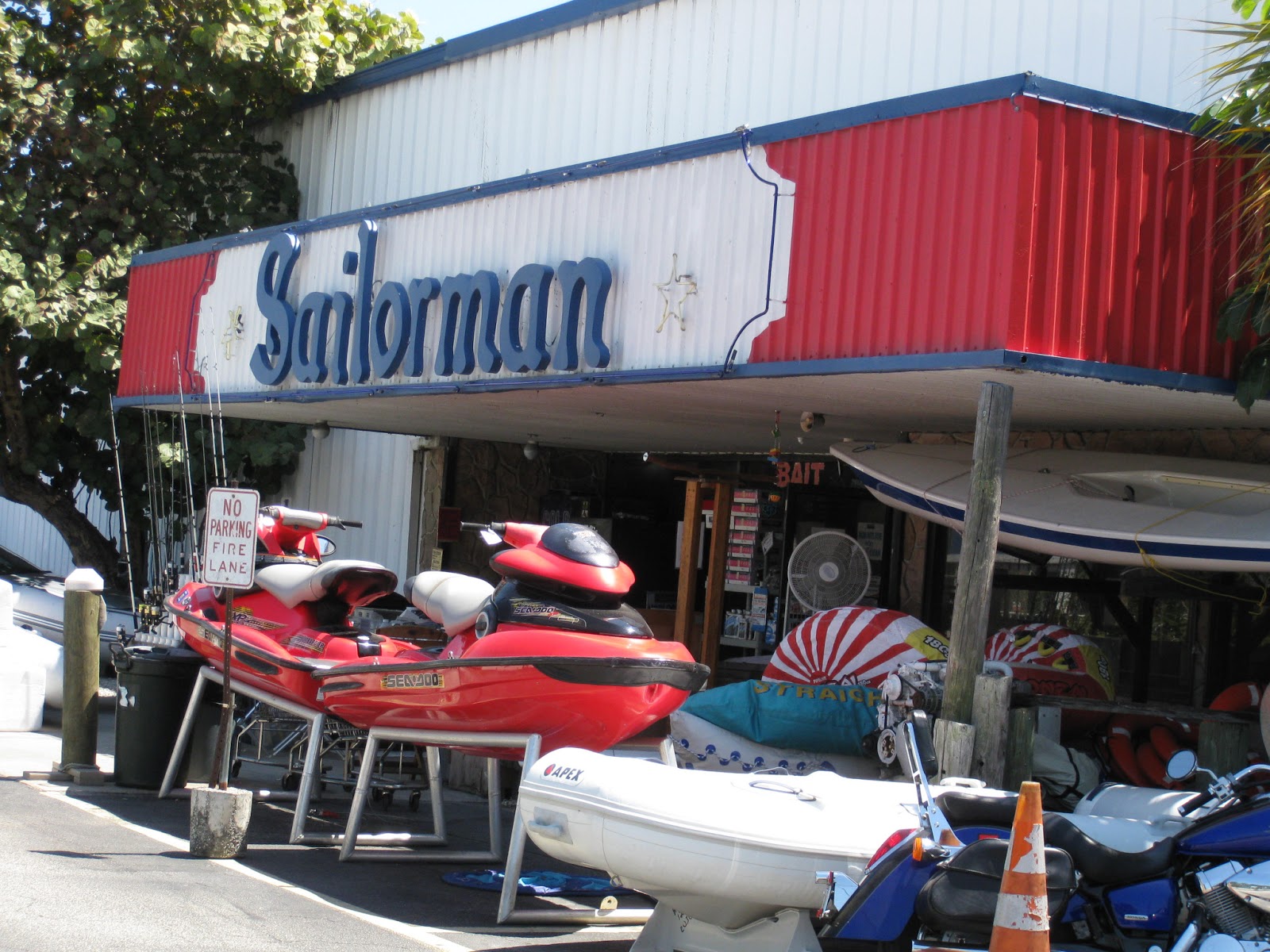
that there is another marine supply store down in Fort Lauderdale called
Sailorman.
Forget the beaches, it is
Sailorman or bust!
Sailors Exchange in St. Augustine, FL.
After a couple days in St. Augustine, we headed south
through the Mosquito Lagoon and the Indian River Basin to Vero Beach.
Mosquito Lagoon was quite a pleasant
surprise.
Mosquito Lagoon is one of the
largest undeveloped sound areas that we crossed, with depths less than five
feet throughout (except the narrow ICW channel), butting up to an expansive
mangrove forest connecting to the mainland.
Birds of all kind lined up along shallow shoals: from white pelicans to
brown pelicans (segregated by color, of course) to egrets to blue herons.
It was invigorating.
At the end of the day, we anchored in 8 feet
just outside of the Titusville mooring field.
We sat in the cockpit, watching the manatees swim around the boat.
The shallow water and warmer temps attract
the manatees to the area, and we were fortunate enough to join them.
Birds resting on rocks in Mosquito Lagoon, FL.
Velcro Beach
A couple of days more of cruising, we were in Vero Beach. The cruising guidebook describes Vero Beach
as ‘Velcro Beach’, as many cruisers end up staying here longer than planned,
primarily due to the amenities. We were
soon to experience Vero Beach amenities, whether we wanted to or not.
I didn’t think I had an aversion to Sundays, other than
growing up Catholic and going to church every Sunday. But after the past two months, I think I have
changed my perspective. From the
cruising perspective, Sundays are the worst day to break down, and for some reason,
we keep breaking down on Sunday. And to
make matters worse, it is often the Sunday preceding a major holiday. Luckily, most of the major holidays are
meaningless for grease monkeys, and we only have to wait one day for help.
Well, our latest cry for help happened on a Sunday morning,
the day after we arrived in Vero Beach.
We woke up after a very cold chilly night, and checked the engine oil
level before starting the motor, as all good cruisers do. This morning’s oil check was different and
highlighted the importance of the ritual; the oil level was twice the level as
the previous day. How could this
be? We double and triple checked, only
to see the same result. Based on a quick
statistical analysis, we concluded that our measurements were reproducible (or
precise), and likely reflect reality (or accurate). There was some matter, most likely liquid in
phase, that was infiltrating the engine oil.
Based on the consistency of the oil, it was not likely to be water-based,
and so the conclusion was that diesel (another hydrocarbon) may be infiltrating
our engine oil. Where could this take
place? The most likely point of
infiltration was the fuel injection pump, which is lubricated with engine
oil.
After a night in the boaters lounge mixing with the local
‘moorers’ while waiting for laundry to dry, we found out that there was a
marine repair guy living in the marina.
We contacted him on Monday, and within an hour, he appeared at Layla and
came to the same conclusion.
He took our
fuel injection pump off to be serviced, and we were amazed.
We found out that the parts would take about
a week to come in.
So, we anticipated
that our job would be next in line once the parts arrived.
Another week went by with what appeared to be
little progress.
We were beginning to
think that we were the next victim of ‘Velcro Beach’.
Finally after two weeks of waiting, the fuel pump was serviced, and within
two days, installed.
Pete removing the fuel injection pump.
Some people call Vero Beach, ‘Zero Beach’.
For us, Vero Beach turned out to be a golden
peach.
We never expected to spend over
four weeks in one city along the Atlantic Coast, but in doing so, discovered
the city free bus system, which gets you to all major cruisers destinations (a
top notch grocery store, WalMart, West Marine, etc); the beach, which we hadn’t
seen or explored this entire two month trip; a fantastic library accessible by
the bus system; and a fantastic weekly farmers market, with fresh local
tomatoes, English cucumbers, fresh French bread and pastries, corn, and much
more.
With limited internet access in
the anchorages and moorings, we are learning the value of the local
library.
Vero Beach has one of the
better library systems that we have visited.
We spent a day doing ‘homework’ today, and got more done there than we
could for a week at the mooring wirelessly.
Sunset at our mooring in Vero Beach, FL.
Reflections in the morning at our mooring in Vero Beach, FL.
The turquoise waters of Vero Beach, FL.
We also found time to discover the abundant wildlife in the
area:
from the roosting pelicans just
off our mooring, the jumping mullet, the dolphin splashing fish up into the
mangroves, and the cruising manatees on their way to their favorite feeding
grounds.
It has been fun to see and live
with all the wildlife here.
Pelicans roosting in the cedars adjacent to our mooring.
A friendly anole hanging out at the bus station bench.
Woodpecker busy collecting dinner from a palm tree.
In addition, this time has given us the opportunity to
repair/optimize/clean a couple of systems on the boat: including figuring how
to charge the batteries with our Honda generator, getting our KISS wind
generator operational, replacing a new copper foil track that had corroded and
disintegrated along the center line of the boat for the SSB ground system, cleaning
the ICW smile off the hull, learning about marine navigation apps for our ipads,
and figuring out how to establish a ‘weather resistant’ repeater unit in the
cockpit to access our navigation software on a computer at the nav station.
Most of these projects are still ongoing. We did have complete success with getting our
EU2000 Honda generator to charge our battery bank using our Freedom COMBI
Inverter/Charger, Model 25. This was one
of those critical tasks. Although we don’t
have a lot of power needs on the boat, the fridge and freezer do demand daily
power. And remember, we were without an
engine while the fuel injector pump was being rebuilt. So we could not charge up the batteries by
running the engine, and we could not motor the boat over to the docks to plug
into shore power. And then on top of it,
the broken wind generator was not helping much either. When we tried charging our batteries the
first time with the Honda, the generator would overload and go into idle. We met a couple moored adjacent to us in the
marina on the bus one day, and they had experienced the same problem. Tom from Circe revealed the key to
success: decreasing the ‘power sharing’ on
the Heart Interface control panel to 15 or 20 amps. Once we lowered the power sharing amperage
needs, we have been able to fully charge our battery bank daily.
We are still working on the KISS wind generator.
When we bought the boat, the previous owner
told us that the wind generator wasn’t working, but he had bought a repair kit,
and he was convinced it would be a simple fix.
We replaced everything that could be replaced (bearings, seals, etc.),
but found out that the problem was a result of the rotor being slightly out of
alignment (the stator is a very powerful magnet).
We finally got the wind generator working
while Layla was on the hard, but just before we put her in the water last
summer, someone in the boat yard hit the generator with a crane, and knocked the
shaft out of alignment.
And so, while at
Vero Beach with ample time on our hands, we decided to revisit the old problem
once again.
We took old ‘Jennie’ down and
up multiple times, realigning the rotor (the shaft) within the stator (the armature),
and sometimes were lucky enough to get her going for some time.
But eventually, the shaft would move just
slightly and the blades would no longer rotate freely.
We finally found help from the internet, from
another cruising blog describing a similar problem, and are now working with
the US distributor, Hotwire Enterprises out of Tarpon Springs, FL.
They seem a lot more business oriented than
the inventor and very knowledgeable, and hope that we can get it operational before
we leave Vero Beach.
Fred, Ernie, and Bud, in deep prayer, to the gods of the KISS wind generator, as they disassemble and reassemble 'Jennie' again and again.
Bud and Ernie, 'realigning' the rotor and stator. Sometimes a hammer helps to release frustrations.
Bud giving 'Jennie' a little hand to encouraging her.
Installing the new copper foil was a partial success.
We improved our SSB reception and
transmission dramatically (we now have decreased the standing wave ratio from
2.5 to 1.5).
However, we still have some
improvements to do.
In the process of
laying down the new track of copper foil, we discovered another track that was
removed.
We have enough copper foil to
replace that track as well, and hope this gives us even better transmitting
power.
We will keep all of you posted,
hopefully by email from the SSB.
Fred helping install new copper foil for the SSB ground system.
As far as the ICW smile goes, the toilet bowl cleaner called
‘The Works’ did as well as the internet described. ‘The Works’ is based on hydrochloric acid,
which is a much stronger acid than the more commonly recommended products
containing oxalic acid and is not organic based, and so is more likely to
remove the ICW tannins and less likely to remove the hull wax. It probably took a couple minutes of soaking
with reapplication of undiluted ‘The Works’, but once soaked long enough, the
smile disappeared.
Right now, we are still novices with the ipad apps, but have
learned about Active Captain, which is integrated into several apps. Active Captain is a web portal, integrating
cruising experiences from the cruising community, including marina, anchorage,
and hazard information along the ICW. Too
soon to report on our favorite, as we are still becoming familiar with
vector-based (integrating information from all the charts-of-old to allow for
seem-less integration of charts) and raster-based (similar to the traditional
charts-of-old, with each chart limited to specific areas, and pulling up the
respective regional chart as you go) charts, but believe that a combination of
both is probably the way to go.
As for the repeater unit, we are currently using an old slow
Panasonic Toughbook to access a relatively new speedy Le Novo ThinkPad wirelessly
via Remote Desktop. It does work, but
the refresh rate of the ThinkPad is far too fast for the old Toughbook. We will probably still play around with the
Toughbook for a while, but may consider another bigger/faster alternative in
the future.
Overall, we have found that the time spent in Vero Beach has
been productive, satisfying, and even fun.
Although it has been good, we are looking forward to leaving. Once the parts for 'Genie' arrive, I imagine we
will be heading out soon. We will keep
you posted.
Cruising Redefined
Bud has redefined the meaning of cruising based on our first
two months of this journey. The Oxford
dictionary defines cruising as “sailing about in an area without a precise
destination, especially for pleasure”. Some
say that cruising is another word for fixing your boat in exotic far-away
places. From our experience, cruising is
just another word for scouting out all the remote hardware stores at every
anchorage, mooring, or docking along the way.
My dad would be proud; from a very young age, I served as my father’s
apprentice, which included at least one trip to the Ace Hardware store every
weekend. The learning experience has
helped me navigate….not the waters of the ICW, nor the currents around the
world, but the aisles of any hardware store across the globe.